
Nikro Air Duct Cleaning in St. Paul: A Homeowner’s Guide
Not every truck that pulls up to your curb carries equipment that can actually clean a duct system. The duct cleaning trade has no universal equipment standard, so a “$99 special” crew and a commercial-grade contractor can both call themselves duct cleaners. The difference is what’s sitting in the van, and whether the person quoting you can tell you its CFM rating. This guide explains what Nikro equipment is built to do, so you can ask sharper questions of any contractor you’re evaluating in St. Paul.
What is Nikro equipment, and why is it a benchmark?
Nikro Industries manufactures the heavy equipment that professional duct cleaners and restoration contractors rely on: negative air machines, HEPA-rated vacuums, and rotary brush systems built for commercial-scale duct volumes. When a contractor says they run Nikro equipment, they’re telling you their setup was designed for large jobs where debris loads are heavy and containment matters. That’s a different class of machine from the shop-vac-tier units common among cut-rate outfits.
Here’s why that distinction matters. Duct cleaning has no licensing body that grades equipment, and no universal standard that says a “duct cleaner” must own a certain machine. Anyone can buy a wet/dry vac, print a coupon, and go into business. That doesn’t make every low-cost operator dishonest – but it does mean the burden of proof is on you to ask what they’re running.
Nikro’s machines are built around a few core functions:
- High-volume negative air pressure to pull debris into a contained collection system rather than agitating it loose.
- HEPA-rated exhaust filtration so what comes out of the machine doesn’t get blown back into your home’s air.
- Rotary brush and contact tools that physically scrub duct walls, not just blow air through them.
- Durable construction for commercial-scale volumes – the kind of workload a residential crew only touches on heavy residential jobs.
If you’re comparing quotes in St. Paul, ask what equipment the contractor uses. If the answer is vague, that’s a data point.
How does negative air pressure actually clean a duct system?
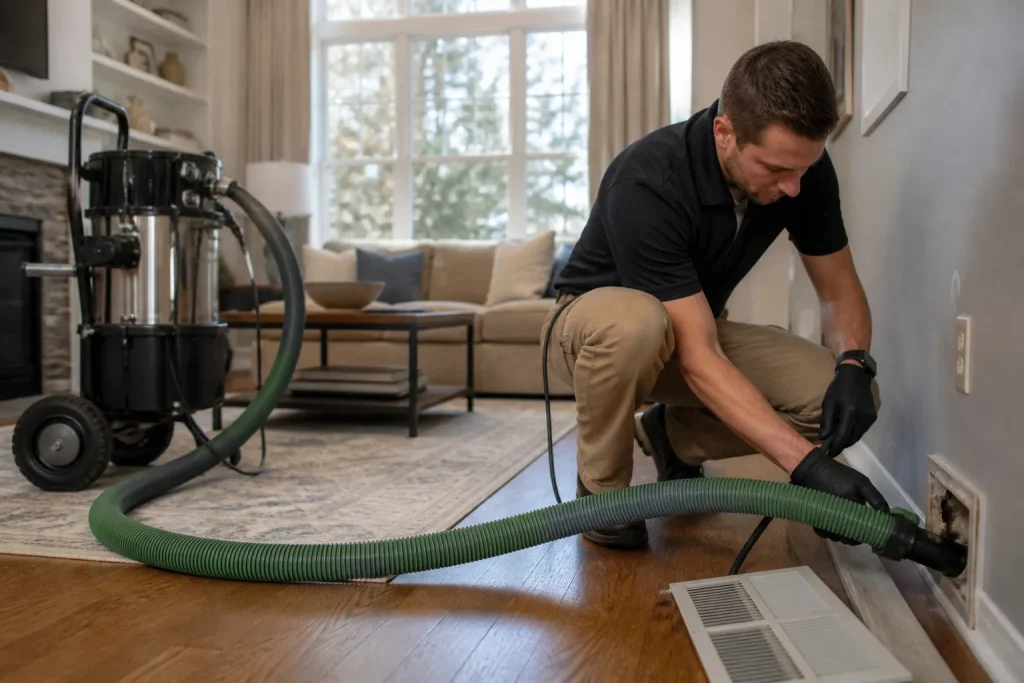
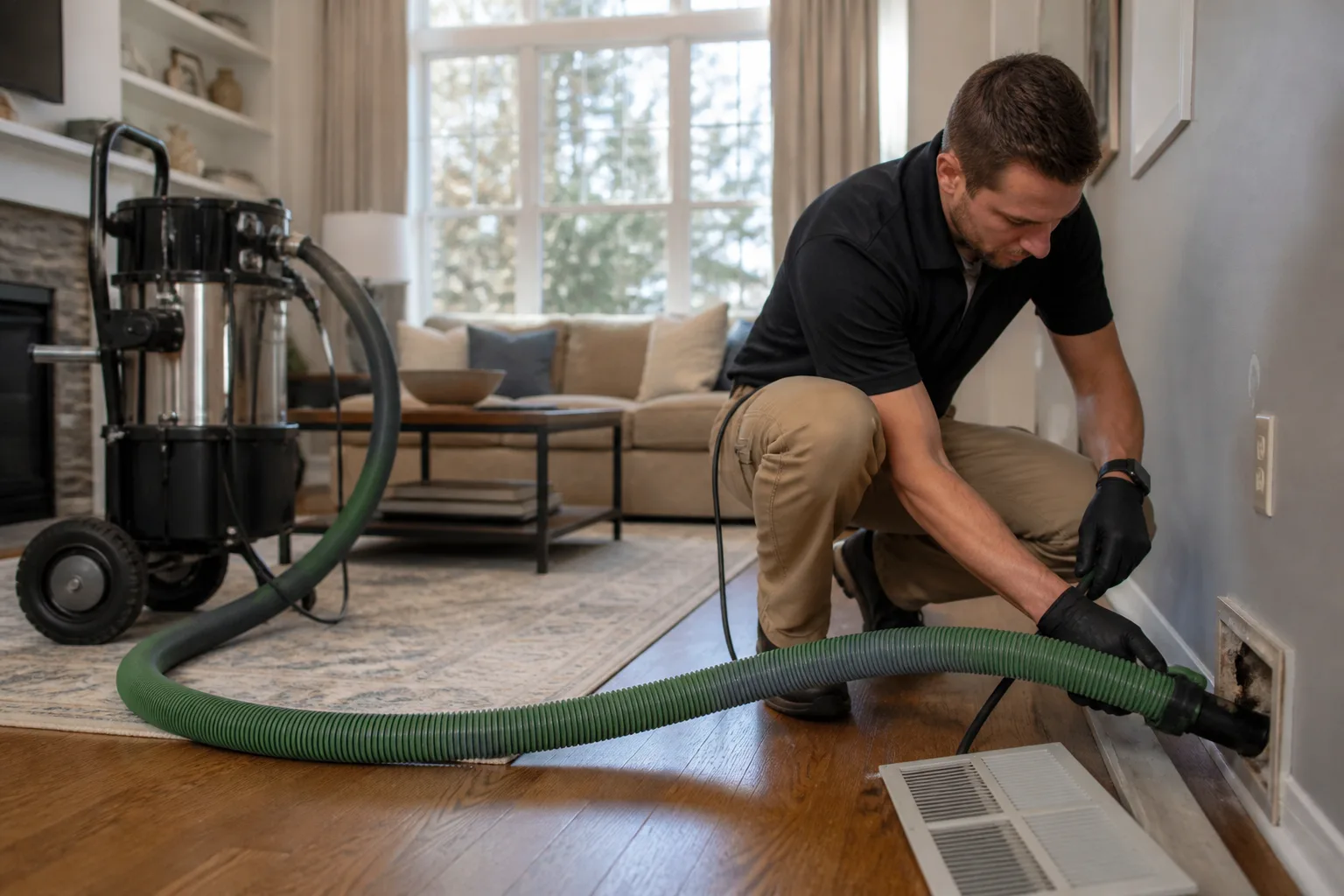
Negative air pressure is the working principle behind professional duct cleaning. A high-volume vacuum unit connects to the duct system and pulls a strong vacuum, so the system is under negative pressure: air and debris move toward the machine, not into your living space. Meanwhile, the technician runs contact tools through the ducts to break loose what’s stuck to the walls.
The number that matters most is CFM – cubic feet per minute, the vacuum unit’s airflow rating. A high-CFM machine pulls enough air to actually extract debris from long runs. A weak machine can’t move enough air to do that, so it agitates debris without containing it. That debris has to go somewhere, and often it resettles in the ducts or gets pulled into your living space.
This is where equipment quality becomes a health question. In our experience, the biggest complaint about cut-rate duct cleaning isn’t that nothing got done. It’s that the homeowner’s allergies got worse for a week afterward, because loose dust was redistributed through the house instead of extracted. A vacuum with real CFM and HEPA-rated exhaust filtration prevents that.
So the CFM rating is one number you can ask for. So is HEPA certification on the exhaust. A contractor who can quote both is a contractor who knows their machine. If the answer is a shrug, keep asking around. St. Paul has plenty of reputable operators, and a few who will happily sell you a coupon special that doesn’t clean much of anything.
Why does equipment matter more in older St. Paul homes?
Older homes in St. Paul tend to have longer duct runs, more joints and transitions, and more debris accumulated over decades. Duct systems in homes built mid-century were often designed on principles that predate modern filtration standards, which means more places for dust to settle and more places for a weak vacuum to leave it behind.
Longer runs mean more resistance to airflow. A vacuum unit needs enough CFM to compensate, and a weaker machine can’t. More joints mean more hiding spots where dust collects, and those spots need contact cleaning tools to be scrubbed loose, not just air agitation. More accumulated debris means heavier loads that a light-duty machine simply cannot handle.
Nikro equipment matters more in these homes because it’s built for exactly this scenario: heavy loads, long runs, and homes where the duct system hasn’t been touched in years. On a newer home with a short, simple duct layout, almost any vacuum can make some improvement. On a 1950s St. Paul rambler with a long main trunk and multiple branch runs, the equipment is the whole ballgame.
If your home was built before 1980 and you’ve never had the ducts cleaned, that’s a data point worth mentioning when you call. A contractor who does this work in St. Paul regularly will already expect longer runs and heavier loads on homes like yours.
What questions should you ask any duct cleaning contractor?
Ask four questions before you book anyone, in St. Paul or anywhere else. The answers will separate the operators from the pretenders faster than any review.
- What equipment do you use, and what’s the CFM rating? A professional can tell you the make and model. A coupon crew usually can’t.
- Does your exhaust have HEPA filtration? This determines whether debris is contained or released back into your home’s air.
- Do you use contact cleaning tools? Rotary brushes, whips, and air-driven tools that physically scrub duct walls are what professional cleaning requires. Air-only “cleaning” doesn’t remove what’s stuck to the walls.
- Do you do repairs? Ductwork can have disconnected joints, crushed sections, or torn flex duct that cleaning won’t fix. A contractor who can’t repair what they find will clean around it and leave a problem behind.
Here’s a fifth question, less technical but just as useful: “What does the price cover, and is it the full price?” That one filters out the bait-and-switch operators whose “$99” turns into a much larger invoice once the technician is standing in your hallway.
How do we use Nikro and Rotobrush in our own process?
We run professional-grade equipment on every job – Rotobrush contact-cleaning systems and Nikro vacuums – because that’s what’s needed to clean a duct system thoroughly rather than just touch the surface. The Nikro machines give us commercial-scale suction and contained debris removal, and the HEPA-rated exhaust means we aren’t pumping dust back into your home’s air while we work.
We also carry Abatement Technologies equipment for jobs that involve contamination concerns, mold, or containment requirements. Most residential jobs don’t need it, but when they do, having it available means we can handle the situation rather than referring it out. We repair ductwork too, which is a differentiator: short of a handful of companies, most residential duct cleaners clean around a disconnected joint and call it done.
Where appropriate, we’ll also talk through filtration and whole-home air quality options from Honeywell and Aprilaire. That’s not a sales pitch – it’s information you can use or ignore. If your ducts are cleaned and your filtration is still a cheap 1-inch filter, that filter is doing most of the work and it’s doing it poorly. A contractor who can explain that is a contractor worth talking to.
Our technicians have up to 10 years of experience, and we’re happy to walk you through the equipment questions above. If you’d rather start with a straight answer, call us and ask.
When should you call a pro instead of doing it yourself?
Call a professional when you can see dust blowing out of supply vents after the HVAC runs, when you’ve just finished a renovation that produced heavy drywall or sawdust, when you’ve never had the ducts cleaned in an older home, or when someone in the house is reacting to the air. Those are the situations where a proper cleaning makes a measurable difference, and where DIY attempts usually make things worse.
Here’s the on-brand touch of humor: ductwork is not a place for a homeowner’s “I’ll rent a shop-vac and save a few hundred dollars” plan. The shop-vac is more likely to blow dust into your living room than extract it from the system, and it can’t reach past the first turn in the run. We’ve seen more DIY regret than DIY success in this category.
We’re a full indoor air quality company, so if you’re comparing options, we’re one of the few that cleans, repairs, and treats ductwork under one roof. If what you actually need is air duct cleaning in St. Paul, we can quote that. If the ducts are damaged, we can fix them. If your dryer is taking two cycles to dry a load, that’s a separate safety matter, and it’s worth knowing that dryer vent cleaning is on the list too.
Related services in St. Paul: If your ducts are cleaned and you’re still seeing dust, the problem may be filtration, disconnected duct sections, or a dryer vent that’s blocked. We can assess all three.
The Bottom Line
The contractor you hire matters less than the equipment they bring and the answers they give when you ask about it. Nikro, Rotobrush, and the rest of our equipment stack aren’t the entire story, but they’re the most visible part of the difference between a real cleaning and a coupon special. Ask about CFM, HEPA exhaust filtration, contact cleaning tools, and whether the company handles repairs. If the answers are clear, you’re in good hands. If the answers are vague, keep looking.
We measure our work by what comes out of your ducts, not what our invoice says. We’ll show you before-and-after photos of your own ducts so you can see what was pulled out, and we set one flat price per system before any work starts. Estimates are free.
If you’re in St. Paul and need help, Ambassador Air Duct Cleaning offers free estimates – call (888) 501-7655. We answer 24/7. Fast dispatch from 7am to 7pm, Sunday through Friday.
Frequently Asked Questions
Nikro equipment pulls high-CFM airflow enough to extract debris from long duct runs, contains debris in a collection system, and passes exhaust through HEPA-rated filtration. A shop-vac can’t reach past the first bend in a run, doesn’t have the airflow to move heavy loads, and can distribute dust back into the home’s air. Call (888) 501-7655 for an exact quote if you want to compare your current setup with professional-grade cleaning.
Estimates are free and the price is set per system based on the size and condition of your ductwork, not per vent. We give you one flat price before any work starts, so the number on the estimate is the number on the invoice. Bait-and-switch pricing starts with a teaser coupon and ends with a much larger bill once the technician is on site; we don’t do that. Call (888) 501-7655 for an exact quote.
Ask for before-and-after photos of your own ducts, taken during the job. A contractor using professional equipment can show you what came out of the system and what the ducts look like afterward. A contractor using weak equipment generally can’t, because there isn’t much to photograph. We provide photos as part of every job. Call (888) 501-7655 if you’d like to know what that looks like in your home.
The cheap quotes usually skip the equipment. High-CFM vacuum units, HEPA exhaust filtration, and rotary contact tools are expensive to buy and maintain, so a company running professional equipment can’t undercut a shop-vac operator on price. A lower number on the coupon doesn’t mean a lower final invoice; it often means a bait-and-switch. Ask what equipment the contractor runs before you compare prices. Call (888) 501-7655 for a real number.
Written by the team at Ambassador Air Duct Cleaning.
Need Air Duct Cleaning Help?
Call Ambassador Air Duct Cleaning - licensed & insured, here with fast help in St. Paul.
(888) 501-7655